
I would like to start my first article on the name of my website name which is “Thrust Reversers”.
Simple Definition:
Thrust reversers are simply the devices on the jet engines that help the aircraft slow down it’s speed after landing, by redirecting the engine’s thrust forward instead of backward.
Normally, the jet engine pushes the air out in the backward direction to push the airplane forward. That’s how the airplanes fly.
Not all airplanes have Thrust Reversers — some smaller aircrafts rely only on wheel brakes. They’re allowed to be used only after the wheels touch the ground (for safety reasons) and not to be used while the plane is in the air.
In short, the Thrust Reversers are like a “reverse gear” for jet engines, helping the airplane stop safely and quickly after landing.
What Thrust Reversers Do:
When the airplane lands, the aim is to slow down quickly and safely, due to which the Thrust Reversers are applied. These Thrust Reversers redirect the same engine thrust to forward (or outward/sideways) instead of backward. This creates a braking force that helps push the plane backward, slowing it down. They are used during the landing specially when the runway is small. They’re also sometimes used when the pilot aborts the takeoff.
How the Thrust Reversers are Activated:
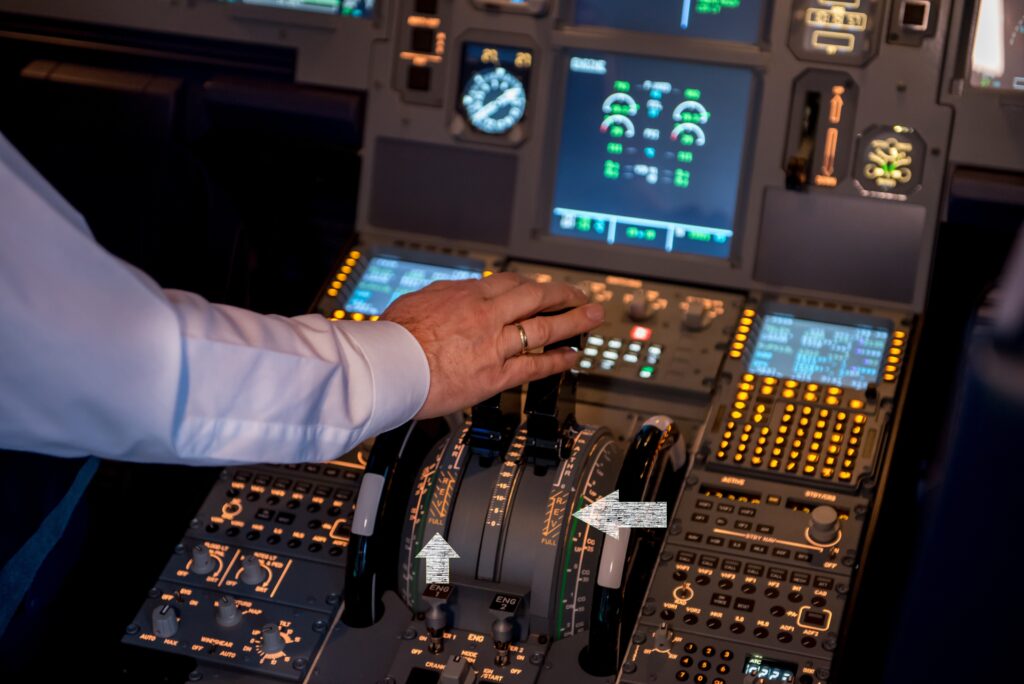
- There’s a lever which is pulled in the cockpit after touchdown.
- Panels or “buckets” on the engine move to block and redirect the airflow.
- We usually hear a loud roar and feel a slight push forward in your seat — that’s the reversers kicking in after landing
Why the Thrust Reversers Useful:
- To reduce the distance needed to stop the airplane.
- To protect the wear on the wheel brakes, since the wheel brakes get wear & tear due to the friction applied while braking.
- Especially helpful on short runways or in wet/icy conditions or while aborting a takeoff, where the brakes alone might not be enough.
Aircrafts Having Thrust Reversers:
Thrust reversers are commonly found on many aircrafts, but are not universal. Here is the list of few Aircraft Types which have Thrust Reversers:
- Commercial Airliners (most widebody and many narrowbody jets).
- Boeing: 737, 747, 757, 767, 777, 787 (most variants).
- Airbus: A320 family, A330, A340, A350, A380.
- Almost all large passenger jets use them since they operate from a mix of runway lengths and weather conditions.
- Military Aircrafts
- Some fighter jets and transport aircrafts have thrust reversers.
- Examples: Saab Gripen, Panavia Tornado, C-17 Globemaster III.
- Not all fighter jets have them — many rely purely on brakes, drag chutes, or arresting gear (like on aircraft carriers).
Note: many smaller planes, some fighter jets, and a few larger aircraft rely on brakes, propeller-based reversal, or other stopping methods instead.
Why Some Aircrafts Skip the Thrust Reversers:
Thrust Reversers add/increases the weight of the aircraft and also adds mechanical complexity. They also increase the maintenance costs.